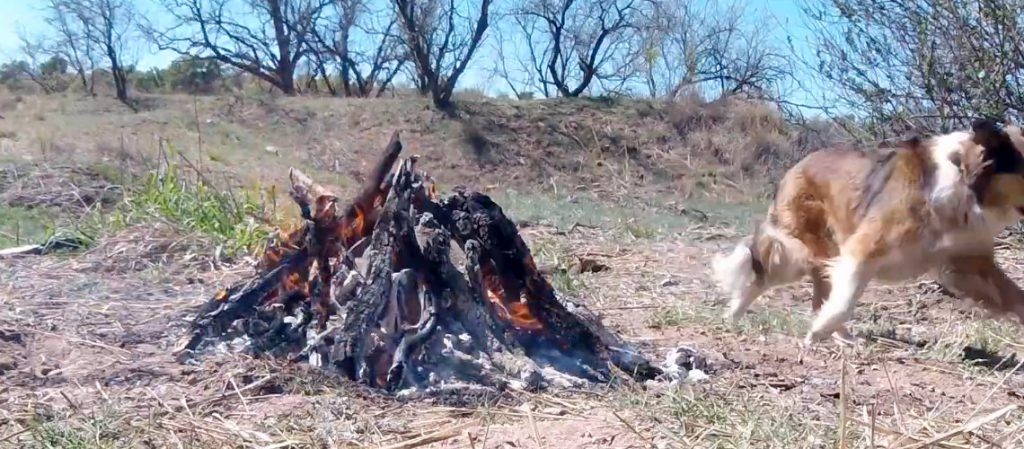
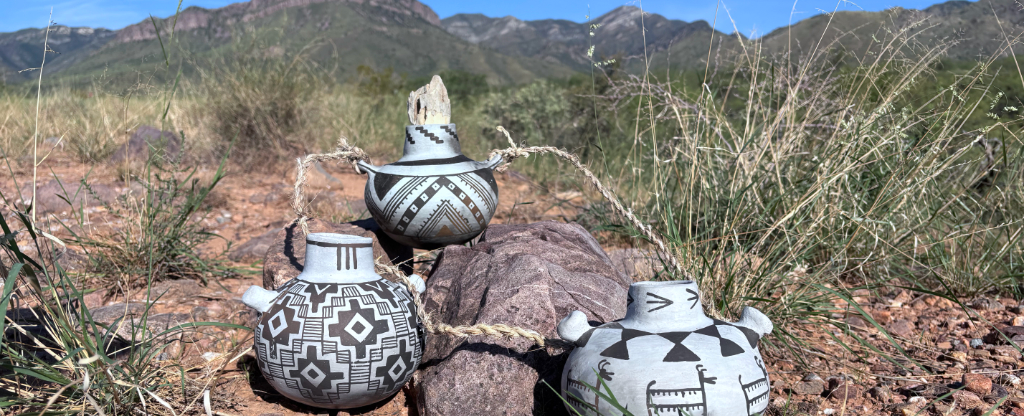
I’ve been making reduced iron black-on-white pottery since 2023. It took years of trial and error—by myself and others—to figure out a reliable method. Before that, potters had been firing organic-painted pottery in reduction trench kilns since the early 1990s. Those trench kiln firings, as they are usually done, have repeatedly failed to reduce iron.
In 2024 I gave a presentation at the Southwest Kiln Conference on how I fire reduced iron, including the tips listed below. During the Q&A, someone asked how my reduced iron firings differ from a standard organic-paint reduction trench kiln firing. At the time I didn’t have a fully developed answer. I said my fires burned more aggressively and therefore produced more reducing gases than the slower-burning trench kiln firings. Some people questioned that, arguing that trench kilns can burn just as aggressively. I didn’t have a good reply then. Since that conference I’ve done more firings, thought about the problem, and watched more trench kiln firings. Comparing typical reduction trench kiln firings with successful reduced iron pit firings shows what the real differences are—and what elements are critical for a good reduction firing.
At the kiln conference in Bloomfield, New Mexico, last month, I watched a standard reduction trench kiln firing fail to reduce iron again. In light of that failure let’s discuss how I reduce iron in contrast to how trench kiln firings fail to reduce iron.
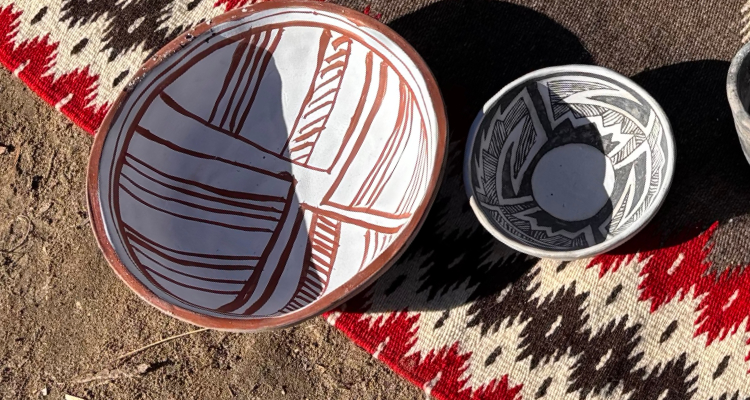
The latest in a long line of trench kiln firing failures with iron paint. Left iron oxide painted bowl, right organic painted bowl both fired in the same trench kiln firing SW Kiln Conference September 2026.
I already knew how to reduce iron before I ever tried to do it deliberately. When you fire on the surface (which I have done a lot) you can see the pottery much more clearly. Experience had shown me that a vigorously burning fire will reduce red iron paint to black; the hard part wasn’t reducing iron but keeping that black from re-oxidizing to red as the pot cooled. Eventually I found that smothering with earth in the same manner as trench kilns are fired, was the most effective way to keep the iron paint from re-oxidizing. So with all the similarities between the way I am firing and the way trench kilns are fired why are the trench kiln firings repeatedly unsuccessful at reducing iron?
It is my belief that the typical trench kiln firing simply does not burn intensely enough to produce enough reduction gasses. It starts more slowly and burns more slowly overall, it may reach the same peak temperatures but takes longer to get there. Compare the flame lengths in the two firings below as a rough measure of fire intensity. Part of the difference seems related to fuel: the large-diameter, chainsaw-cut wood commonly used in trench kilns burns longer but less vigorously because it has a lower surface-area-to-volume ratio than the smaller, arm-thickness branches I use. Also the fuel is arrange much flatter over the pottery, allowing less air to access the burning wood. In the photo below both firings are in pits with the pots arranged below ground level, yet in the photo of my firing on the right the wood is much higher and more vertically oriented, this encourages a more vigorously burning fire with a better fuel-air mixture.
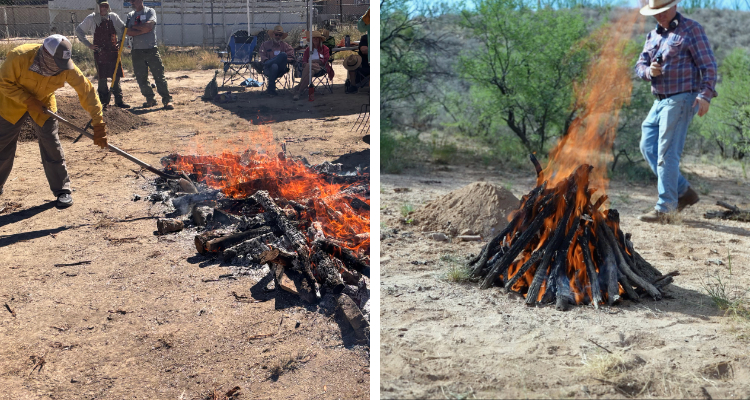
Trench kiln firing on the left at the 2026 Southwest Kiln Conference September 2026. Reduction pit firing on the right August 2026. Notice the difference in flame length which is an indicator of fire intensity.
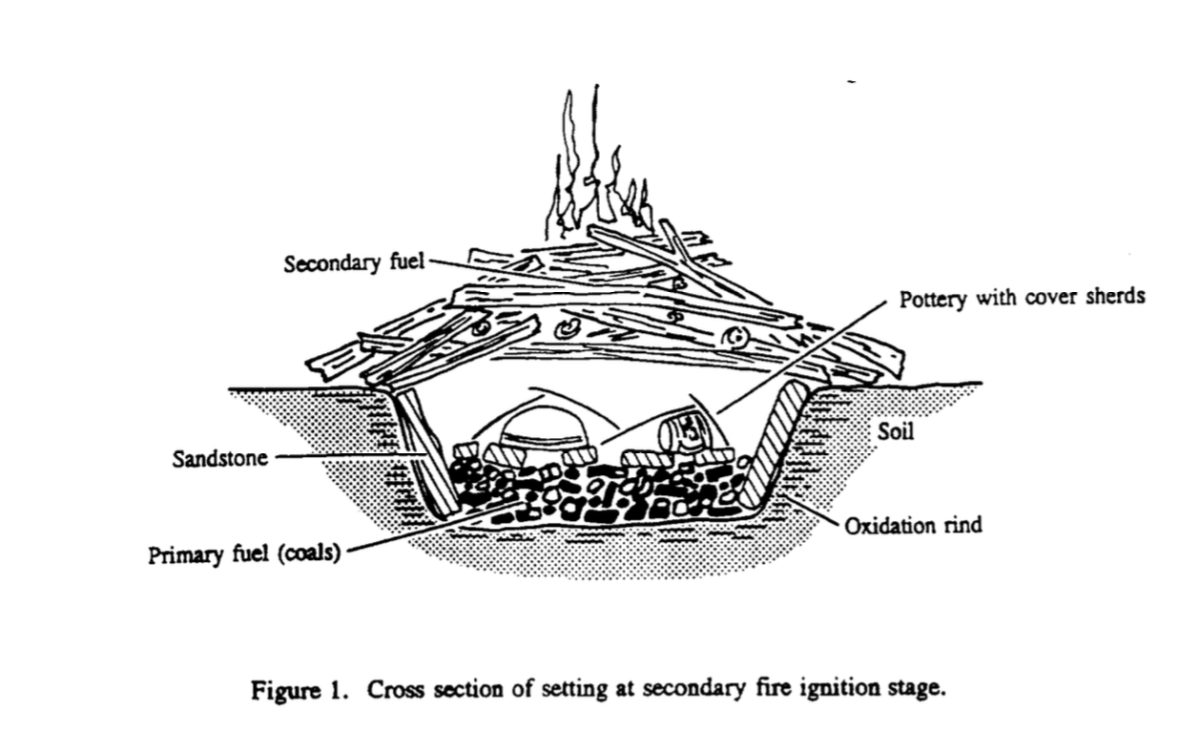
Clint Swink’s illustration of a typical trench kiln setting shows wood stacked far too flat and dense, from “Limited Oxidation Firing of Organic Painted Pottery in Anasazi Style Trench Kilns” in Pottery Southwest Vol. 20 1993
The people who lived in the Mesa Verde region transitioned from mineral paint (reduced iron) to organic paint in the late 1100s. We know they used similar-style trench kilns both before and after that transition. The firing method must have been close enough that the switch was relatively straightforward. Theoretically when they were in the midst of switching from mineral to organic paint they must have fired both together in the same trench kilns. So the way they fired was likely able to be successful with pottery painted in either way.
I have actually seen organic paint and mineral painted black on white pottery fired successfully in the same firing. It took place in Montana last year, in the summer of 2025, my friend Justin Deacon fired two organic-painted pots, and I had a mineral (iron oxide) painted ladle in the same firing. He used relatively small-diameter juniper piled high to produce a vigorously burning fire, then smothered it with sand after it burned down to coals. The result was three perfectly fired pots—both the reduced organic-painted pieces and the reduced iron-painted piece. This is almost certainly how it worked for the Mesa Verde potters when they switched paints: the firings stayed essentially the same, and both paint types continued to work.
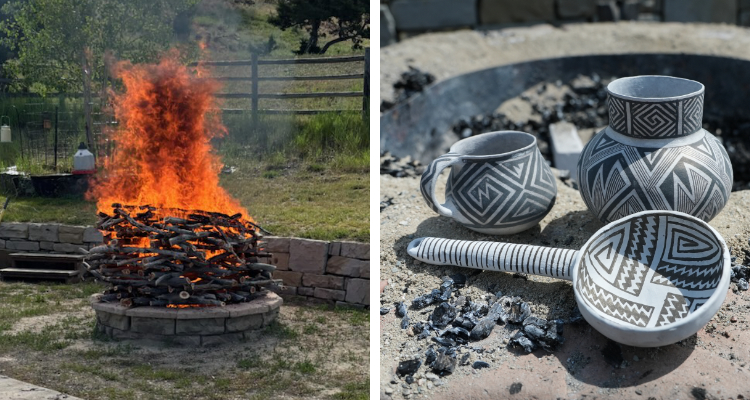
Vigorously burning fire on the left by Justin Deacon June 2025. Finished pottery on the right from the fire showing both organic painted pots and reduced iron painted ladle.
The method for firing a trench kiln was developed by Clint Swink and others back in the early 1990s. They had archaeological evidence in the form of ancient trench kilns and the stratigraphy of ashes, sherds and charcoal found in those kilns, but one thing they didn’t have was any idea of how the ancient potters built fires over those kilns. It was all conjecture but they did find a way to fire them that works for turning organic paint into black designs on fired pottery. But I think the fact that this method of firing consistently fails to reduce iron is a clue that they have the fire wrong.
We know it can be done because Justin Deacon did it last summer in Montana. I think it is time to try firing a Mesa Verde-style trench kiln using only technologies and materials available to the ancient potters. No shovels moving coals around, no screening the smothering earth to remove sticks and roots, and—most importantly—no chainsaw-cut firewood. Build the fire so it burns vigorously, with a good fuel-air mix. In a firing like that, I believe we could accomplish what the ancient Mesa Verde potters accomplished: both reduced iron and reduced organic paints in the same firing.
Tips For a Successful Reduction Firing
- Select a type of wood that will produce long-lasting coals.
- Dig the pit large enough to support air circulation all around the pots.
- Take your time with the primary fire and produce a deep bed of coals.
- Use large stones to hold your pots well above the coals.
- Build a big, vigorously burning secondary fire.
- Coals should cover everything by the end; move coals around as needed so everything is covered.
- Wait until no flames or smoke are observed before smothering.